


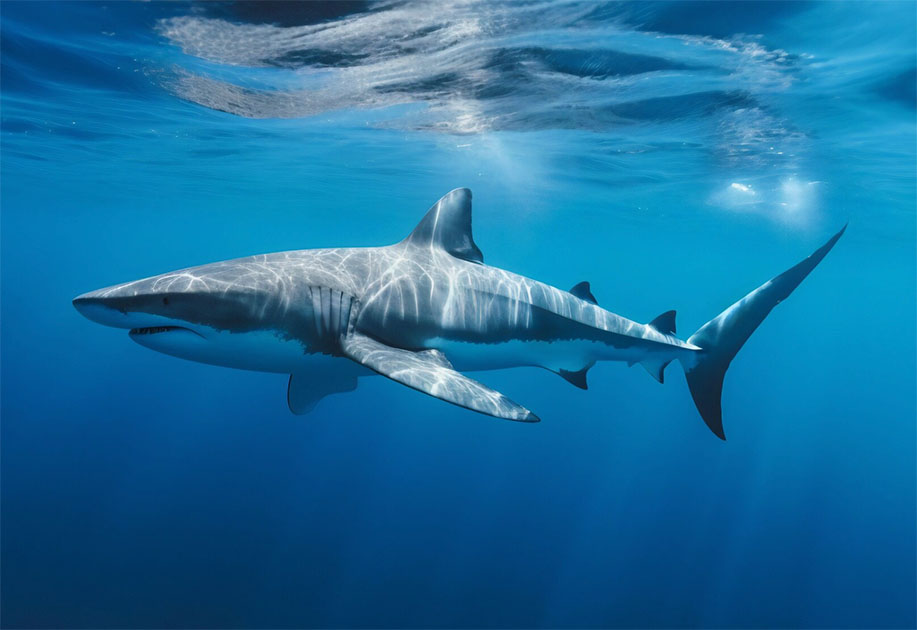
Imagine: somewhere in the pitch-black, icy waters of the North Atlantic, a shark swims around that may have been born when Galileo’s ideas were still fresh, long before electric lighting, long before Belgium existed. And it’s still out there.
Sounds like mythology, but this is about a real species: the Greenland shark.
The main character: the Greenland shark
The Greenland shark (Somniosus microcephalus) lives in the cold waters of the North Atlantic and Arctic regions. It’s not a flashy jaw that cleaves through waves, but a slow, silent giant of the deep. That very pace seems to be part of the secret.
Scientists consider it the longest-lived vertebrate known, with estimates of around 400 years.
How do you measure a shark’s age if there are no growth rings?
In many animals, age can be determined from growth structures like rings in bones or scales. But sharks don’t have bones like we do. So how do you prove centuries?
In 2016, a research team published a method that sounds almost like detective work: they used radiocarbon dating on the nucleus of the eye’s lens. This lens nucleus is formed before birth and remains virtually unchanged thereafter. In other words, it preserves a chemical time stamp from the shark’s youth.
Based on these measurements, the researchers found that lifespans can be at least 272 years, and the largest animal studied was estimated to be 392 years old, with a margin of uncertainty that theoretically allows for even longer. In popular parlance, this is often summarized as: up to about 400 years.
A Youth of a Century and a Half
The most mind-boggling thing isn’t even that age, but what that age means.
According to the same study, female Greenland sharks don’t reach sexual maturity until around 150 years old. That’s like an animal only thinking about children when it’s been great-grandparents for generations in humans.
This also explains why the species is vulnerable: if you grow so slowly and mature so late, every additional death is a severe blow to the population.
Living in slow motion, in a place where time stands still
The Greenland shark lives deep and cold. A frequently cited explanation for its extreme longevity is its extremely slow metabolism, adapted to near-freezing waters. NOAA also describes that they can dive very deep, to about 2,200 meters.
Everything about this animal breathes “slowly”: slow growth, slow movement, slow maturation. And apparently, slow aging as well.
“400 years” isn’t a marketing figure, but a scientifically based estimate with margins of uncertainty. The fascinating thing is that we’re not talking about a fairytale creature here, but a real shark that’s still around today, and that may have been alive when microscopes first appeared.
It’s a living time capsule. An animal that not only traverses the ocean, but also for centuries.


