


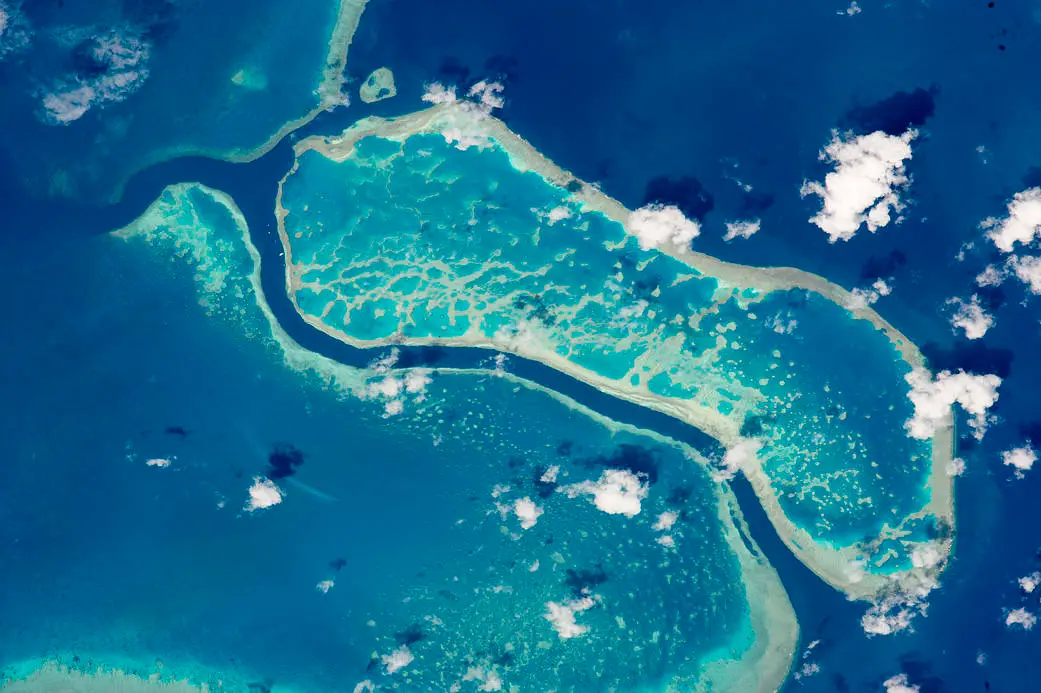
Imagine looking out a window at 28,000 kilometers per hour, suddenly seeing a turquoise glow that looks like a giant handprint in the ocean. Is that really the Great Barrier Reef… or is this one of those persistent internet myths?
First: what do we mean by “space”?
“From space” sounds like floating among the stars, but people usually mean Low Earth Orbit, roughly where the ISS flies. That’s still far, but not as far as “from the moon” or “from deep space.”
What astronauts actually see
Yes, from low Earth orbit, you can see parts of the Great Barrier Reef, especially when the light is favorable and the atmosphere is clear. NASA, for example, published astronaut photos where you can recognize the reef, because shallow lagoons can glow an iridescent blue next to darker deep water. That color contrast is key: not “coral with detail,” but a striking pattern in shades of blue and green.
An important detail: many iconic images were captured with a powerful lens. This makes the view more impressive than what you can always easily see with the naked eye.
Why you sometimes see it and sometimes you don’t
The reef isn’t a bright neon line. It’s a vast system of thousands of reefs, islands, and sandbars. Whether you see it depends on:
- Sun angle: low or angled light can highlight structures.
- Cloud cover and fog: a little haze can “wash out” everything.
- Wave action and murky water: less contrast, less visibility.
- Your exact position: you don’t see the entire reef at once, but only parts of it.
The biggest misconception: “the only living thing you can see from space.”
You’ve probably heard this before. The problem is that this statement is often repeated too absolutely. Some organizations formulate it very definitively, but “visible from space” isn’t a strict yes or no. It’s a scale with conditions: altitude, light, eyes, lenses, air quality.
What is safe to say is that the Great Barrier Reef is so large that it can be recognized from low Earth orbit, and it is often cited as one of the most famous biological structures observable from orbit.
From orbit to moon: where do we draw the line?
This is where things get interesting, because the internet likes to shift distances. “From space” suddenly becomes “from the moon.” There’s a problem with resolution: the further away you go, the smaller everything becomes, until even enormous terrestrial structures merge into a single blur. Reliable, documented claims that you can see the reef from the moon with the naked eye are difficult to substantiate. In other words: the reef is absolutely photogenic from orbit, but don’t get carried away by increasingly grandiose versions of the same story.
What satellites see that we don’t
Satellites like Sentinel-2 can capture the reef in crystal clear detail because that’s precisely what they’re designed for: measuring, comparing, mapping. That’s a different form of “seeing”: not with eyes, but with sensors. This makes the reef not only beautiful but also measurable, which is crucial for monitoring changes.
If you ever hear someone say, “You see it always, everywhere, super clearly,” you already know. The real story is much cooler: you need a perfect combination of height, light, and clarity to see that turquoise wonder illuminate.


