


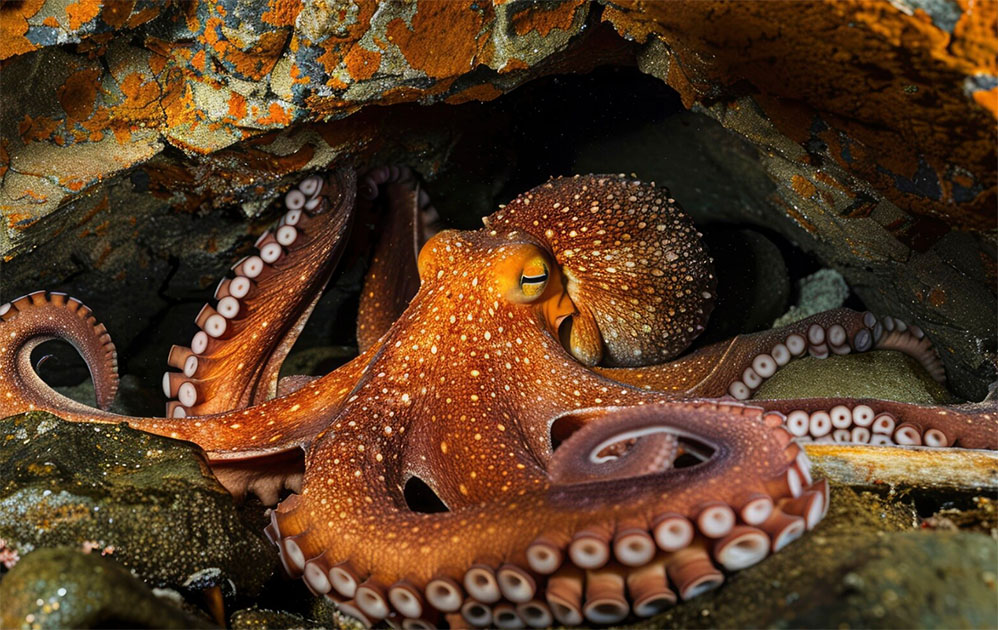
An encounter with something that seems off-planet
Imagine diving into a dark rocky outcrop and seeing an animal that can change color, squeeze through a crack as if it were liquid, and… walks around with three hearts. As if that weren’t strange enough, its body doesn’t have red blood, but blue. It sounds like science fiction, but it’s pure biology.
Three hearts: what exactly does each heart do?
An octopus actually has three hearts, and each has its own function.
Two hearts are located near the gills. Their job is to pump blood to the gills, where carbon dioxide is released and oxygen is absorbed.
The third heart is the main workhorse: it pumps oxygen-rich blood throughout the body, to organs and muscles. The result is a kind of internal “turbo system” that constantly circulates oxygen so the octopus can react quickly, hunt, escape, and solve puzzles with that infamous octopus intelligence.
The plot twist: one heart stops while swimming
This is where it gets truly cinematic. The heart, which supplies the entire body with oxygen-rich blood, can stop beating when the octopus swims. This helps explain why octopuses often prefer crawling across the seabed to swimming long distances. Swimming exhausts them more quickly than you might expect for such an athletic animal.
In other words: that spectacular jet escape looks heroic, but it comes at a price. So the animal often opts for the energy-saving, silent “crawl mode.”
Blue blood: no magic, just chemistry
Why is the blood blue? Not because octopuses are royal, but because their oxygen transport works differently than ours.
We use hemoglobin with iron, which makes blood red when it binds oxygen. Octopuses use hemocyanin, a protein containing copper. When the copper in hemocyanin binds oxygen, the blood turns blue.
This isn’t just a strange gimmick. It is an adaptation that helps octopuses function in conditions where it is cold and oxygen may be scarce, such as in deeper or more difficult habitats.
Why that combination works so well
Three hearts plus hemocyanin is like a specially designed engine for a challenging life underwater.
Hemocyanin transports oxygen differently than hemoglobin, and that whole system revolves around efficiently delivering enough oxygen to a body that sometimes needs to accelerate explosively, but can also sit still and lurk for long periods.
That’s what makes the octopus so otherworldly fascinating: it’s not a “fish with arms,” but a completely different nature’s solution to the same basic problems: breathing, moving, surviving.
The next time you see an octopus…
You’re not looking at just any sea creature. You’re looking at living proof that nature doesn’t have one standard plan, but dozens of ways to build a body.
Three hearts. Blue blood. A surprisingly complex brain. And a body that escapes as if made of shadow. Not fictional. Just real.


