


The moment your brain says “no”
Imagine: the water recedes, the sand still glistens wet in the sun, and suddenly something crawls out of the mud. A fish. Not struggling to its death, but purposeful. As if it has a meeting on dry land.
Many animals do strange things, but this feels like the rules are taking a break. Yet it’s real: there are fish that move deliberately on land and remain active there. One of the most famous is the mudskipper, a type of goby literally called “mud jumper.”
The trick: walking without legs
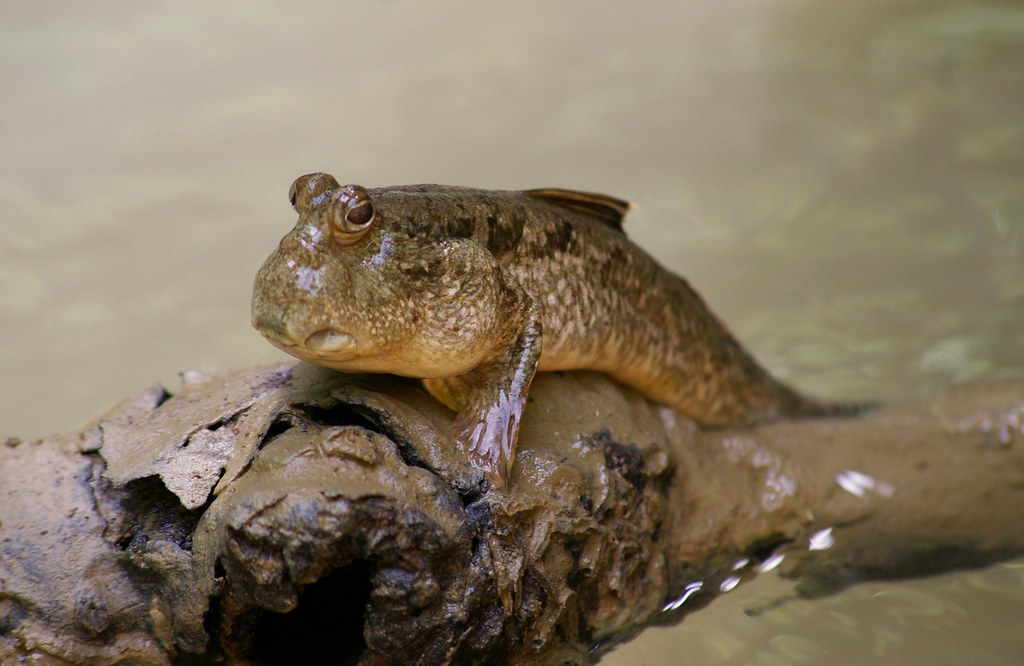
A mudskipper doesn’t walk like a dog or a human. It uses its pectoral fins as support and “crutches” forward: both fins simultaneously forward, then pushes, as if it’s moving on crutches. Its tail also helps, because it can give it extra propulsion, make it hop, and let it dart away quickly when danger threatens.
In their habitat, you will not only see them sliding across flat mud, but also clambering onto mangrove roots or obstacles that would be impossible for a normal fish.
Breathing without lungs, yet on dry land
It only gets truly bizarre when you ask yourself: how do you survive as a fish without water flowing through your gills?
Mudskippers don’t have lungs like we do, but they do have clever workarounds. They can absorb oxygen through their skin, as long as it remains moist. And they can also absorb oxygen through the lining of their mouth and throat. In addition, they retain water in enlarged gill chambers, preventing their gills from drying out immediately when they’re on land.
This combination means they don’t just “accidentally” lie on dry land, but actually spend time there eating, defending, digging, and impressing rivals.
The scene: mudflats where the sea disappears and returns
Mudskippers live in places that change completely twice a day: intertidal zones. When the tide is high, it’s all water. When the tide goes out, it transforms into an open mudflat. And that’s precisely where they rule.
They emerge to search for prey such as small invertebrates and to guard their territories. Some species even build striking mud structures around their burrows, as if constructing a mini fortress in the mud.
Leaping, staring, and fighting like little dragons
As if running wasn’t enough, mudskippers can also jump surprisingly far. They have bulging eyes on top of their heads, allowing them to scan the sky and their surroundings simultaneously like a periscope. This helps them spot prey, but also enemies and rivals.
And there are plenty of rivals, because on those mud flats, space, safety, and reproduction are at stake. It sometimes feels more like a lively street brawl than a “peaceful fish life.”


