


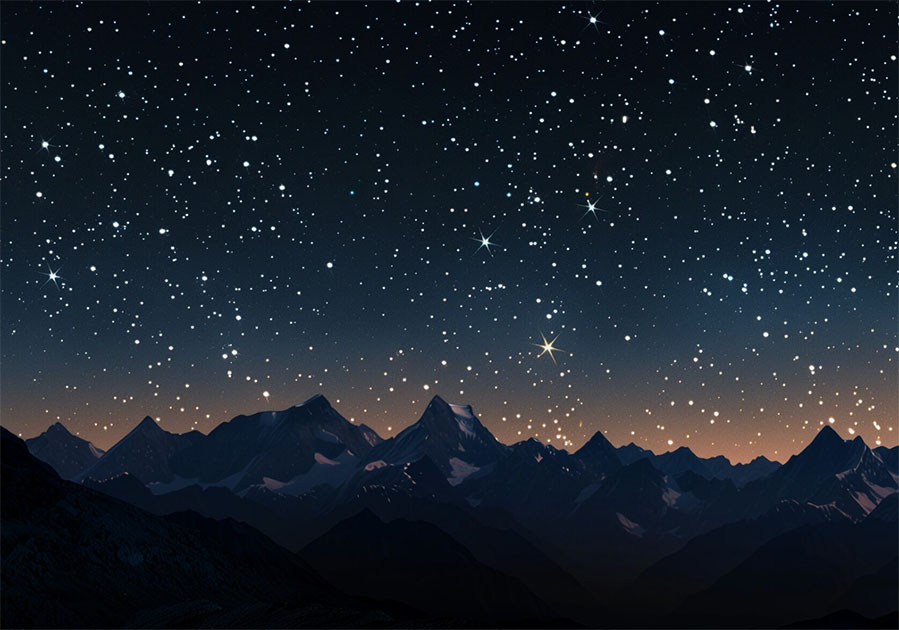
You know how it is. You look up, and the stars seem to blink as if the universe is sending a secret Morse code. But there, a little lower in the sky, stands a “star” that burns remarkably steadily. No flickering. No blinking. As if that single point of light doesn’t care about anything.
And the funny thing is: that difference is often enough to guess what you’re seeing. Star or planet. No app. No telescope. Just you, your eyes, and an invisible trick of the sky above.
The real culprit: the invisible ocean above you
The stars don’t actually do anything special at all. They don’t twinkle “on their own.” It’s Earth’s atmosphere that creates the spectacle.
Between you and space lies a thick layer of air in constant motion: warmer and colder air bubbles, layers of wind, tiny vortices. Each layer has a slightly different density and refractive index. As a result, light traveling through it is constantly bent slightly, as if you were looking through an endless stack of wobbling lenses.
The result: the point of light appears to dance, flash, and sometimes even change color ever so slightly. Astronomers call this scintillation.
Why stars twinkle the most: they’re pinpricks
Stars are so far away that they’re practically point sources to our eyes. A perfect pinprick of light.
And that’s precisely why the atmosphere can “disturb” them so easily. When such a point is deflected by turbulent air, almost all of the light reaching your eye shifts slightly in one fell swoop. It’s like tapping a laser point with one finger: you see it immediately.
That’s why stars twinkle especially strongly when they’re low above the horizon. Their light then passes through much more atmosphere than when they’re almost directly overhead.
Why planets usually don’t twinkle: they’re secretly tiny disks
Planets also appear to be points at first glance, but they’re much closer. As a result, they have a tiny, visible disk: not a pure pinprick, but a tiny ball of light.
And here’s the clever part: the atmosphere can make different parts of that tiny planetary disk wobble slightly differently, but all those tiny variations average out in your eye. What immediately becomes a clear flash with a star averages out into a more stable light with a planet.
In short: a star is a single point of light that is easily disturbed. A planet is a tiny patch of light, and that makes it optically more robust.
Plot twist: sometimes planets do twinkle
“Usually” is the key word. There are times when a planet can still twinkle:
- When the planet is very low above the horizon, the light has to pass through extra turbulent air.
- In a turbulent atmosphere, for example, with strong winds at altitude.
- If you look through warm roof air or above a heated road, you get local air vibrations that amplify the effect.
So if you see Venus twinkling very low as if it were a star, it’s not magic. It’s the atmosphere exaggerating.
A jackpot for stargazers: this is why telescopes sometimes have “bad nights”
Twinkling is beautiful for your eyes, but disastrous for sharp telescopes. These same air vibrations blur constellations, make stars “jump” in the image, and limit the details you can see.
That’s why astronomers build telescopes in places with stable air, such as high, dry mountains, and use techniques like adaptive optics to partially correct atmospheric distortion.


